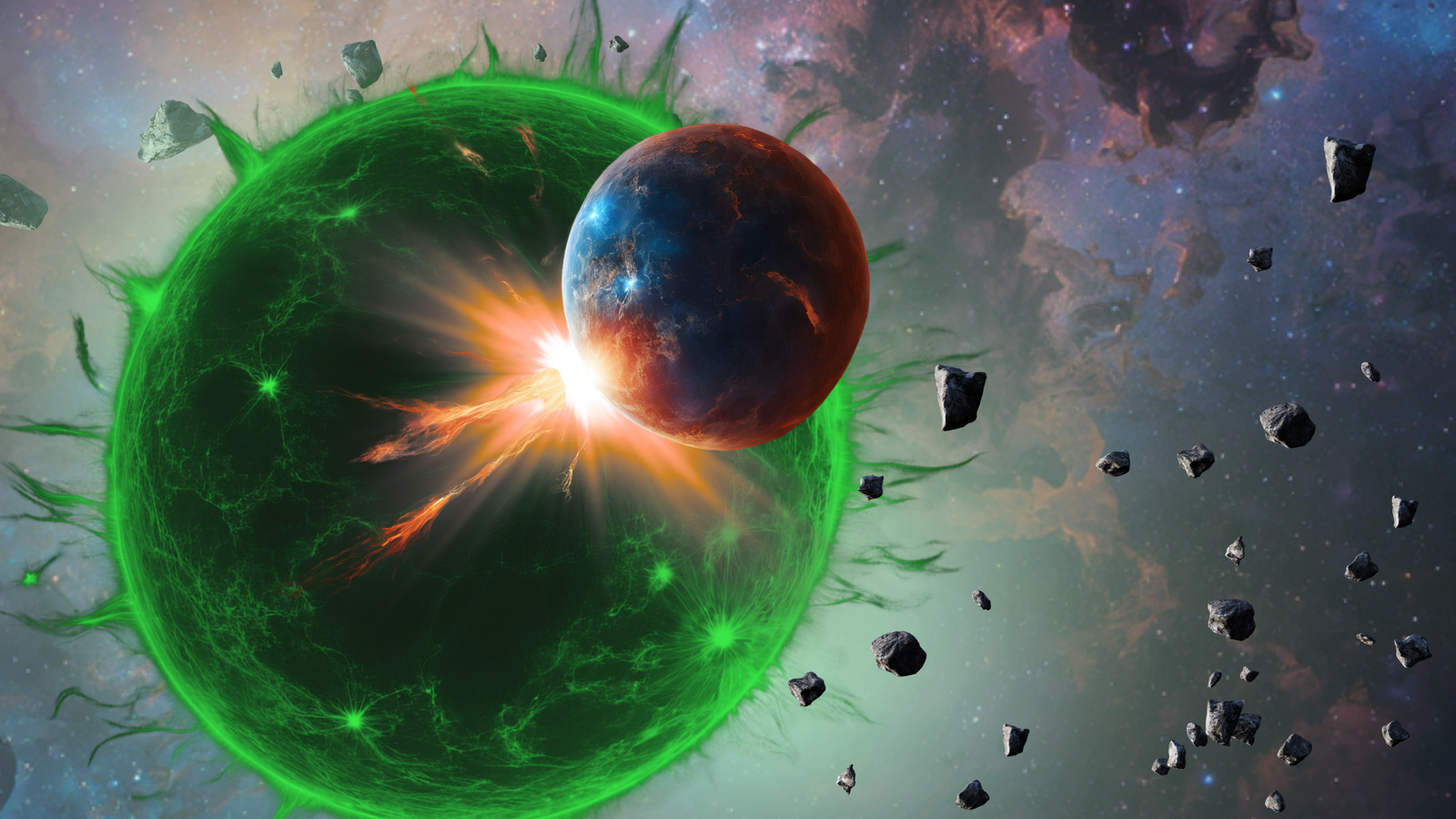
How awesome would it be if the sun could take on a spooky green glow for Halloween? It turns out that scientists have discovered that our star may indeed turn green, but only billions of years after its death – and only if it then starts eating planets like a cosmic zombie.
This is possible because scientists discovered it white dwarfs, the kind of stellar remains that sun-sized stars leave behind when they die can actually take on a range of colors including green if they snack on their rocky planets like cosmic cannibals.
For star scientists, the colors of the stars have always been indicative of their temperature. The most beautiful stars look orange, while the stars like the the sun looks whiteand the hottest stars shine pale blue. This is similar to a blacksmith’s iron that glows red, then orange, then glowing as it heats. Researchers have always assumed that white dwarfs follow the same rule. However, new research suggests that these stellar corpses could glow in a range of colors including green, pink, cyan, yellow and purple. This means that the universe is much more colorful than we suspected.
“Most stars, including most white dwarfs, behave like ‘perfect radiators,’ so their color is determined almost entirely by temperature. But no one had really looked at what else might be possible for white dwarfs,” said team leader Mark Hollands of the University of Warwick in a statement sent to Space.com.
“It turns out that these incredibly dense stars produce colors that no one expected, and some of them really surprised me.”
How white dwarfs break the rules of stellar colors
White dwarfs get their name because when they were discovered they appeared surprisingly hot and glowed white or pale blue. However, this new research suggests that this slightly bland and uniform appearance is due to the fact that no white dwarfs are close enough for Earth-based astronomers to see their true colors.
The key to the rainbow-like range of colors this team suggests white dwarfs might possess is their density. White dwarfs form when stars with a mass approximately that of the sun They run out of fuel and can no longer resist their own gravity, causing their cores to collapse. As a result, the matter that makes up white dwarfs has a density equal to that of water, millions of times denser than the surface of the sun. photosphere.
Under these conditions, elements such as carbon, calcium and sodium can interact with the surrounding dense helium plasma and absorb light in a wider range of colors than at lower densities. This shifts the colors of the white dwarfs away from the white/blue seen for a perfect heat radiator.
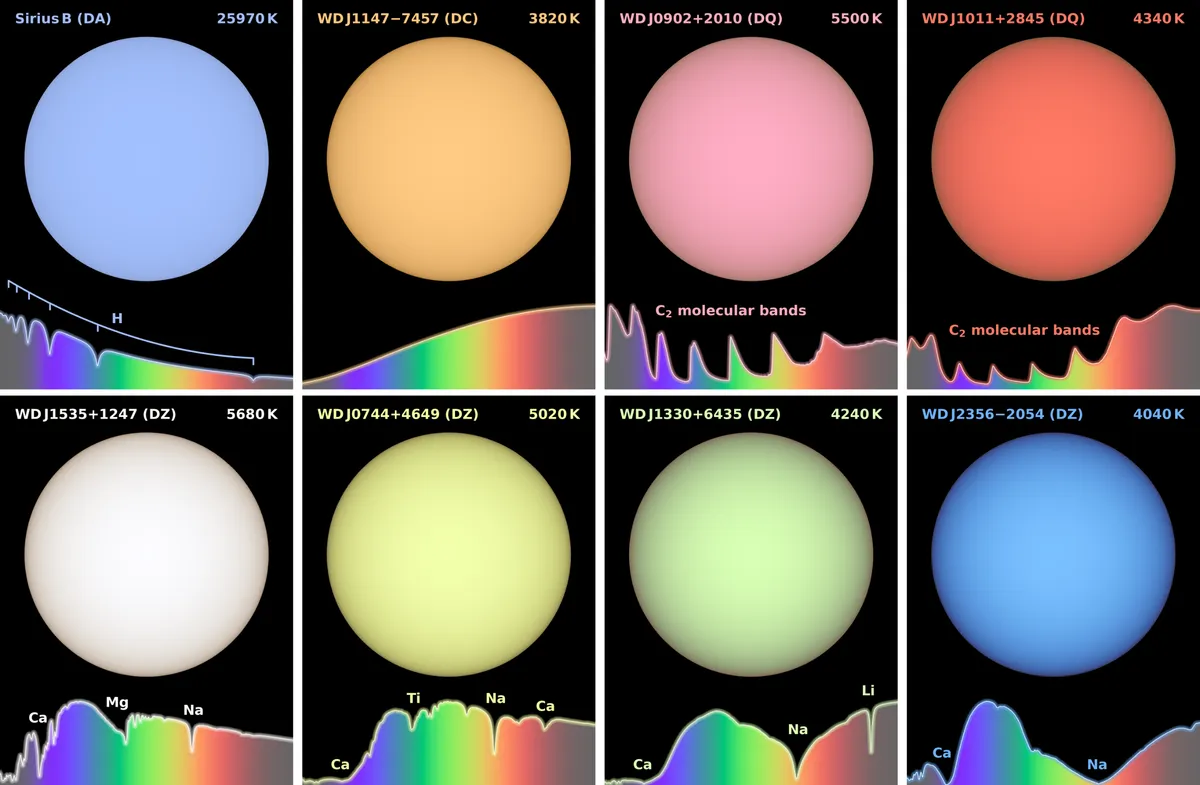
The researchers found that the colors of the white dwarfs would fit into distinct clusters related to the individual chemical composition of the stellar remnant’s atmosphere.
Carbon-rich white dwarfs would be pink or purple, while those enriched with debris from worn asteroids and comets, and remnants of old planetary systems, would take on a more yellow hue. Cooler white dwarfs with mixed atmospheres of hydrogen and helium often glow cyan or pale blue, due to the collision of hydrogen molecules with helium atoms in their dense atmospheres.
One of the most striking examples of white dwarf coloration, however, would arise when one of these living dead stars begins feeding on the planets around it like a horror movie zombie.
Zombie white dwarfs turn green
The researchers found that some dead white dwarf stars can turn a little green around the gills afterwards snack on orbiting planets.
An example of this is WD J1330+6435, a cool white dwarf located about 326 light-years away, which has accumulated rocky material from a planetary companion. This enriched its atmosphere with calcium, lithium and sodium, and the team’s modeling suggests this would have led WD J1330+6435 to adopt a green hue.
But unlike the green-tinged zombies of George Romero’s classic Dawn of the Dead, there are no hordes of these green-faced cosmic zombies… yet.
Researchers believe that no other star, living or dead, has ever been credibly reported as green. This makes WD J1330+6435 the first known truly green star.

“Trace sodium in the atmosphere of this white dwarf absorbs the orange part of the spectrum, leaving behind a ghostly green glow,” Hollands said. “Imagine standing on a planet and looking at a green star. It seems like something out of this world science fiction.”
Scientists see red
The team not only discovered that a known white dwarf is the first-ever green star; they also discovered what could be the reddest star ever seen in the form of the white dwarf WD J1011+2845.
Located just 48 light-years from Earth, this white dwarf has a deep convection zone that transports carbon from its core to its surface. These carbon molecules distort the white dwarf’s light, causing an intense salmon-pink glow unlike any other star.

Despite this rainbow of white dwarfs, the team theorizes that white is still the most common color for these stellar corpses. Only five of the 151 white dwarfs within about 65 light-years of Earth have a striking color. Extrapolating this to the total population of white dwarfs, the team estimates that only one in 30 of these dead stars has an unusual color.
“One in thirty might not seem like a huge fraction, but in the entire population of white dwarfs in the universe, there are still many strangely colored stars,” said Boris Gänsicke, Department of Physics, University of Warwick. “However, if we take the median of a representative population of white dwarfs, we find that the average white dwarf is indeed white.”
The team’s research was published Thursday (October 14) in the journal RAS techniques and tools.
About the Author


