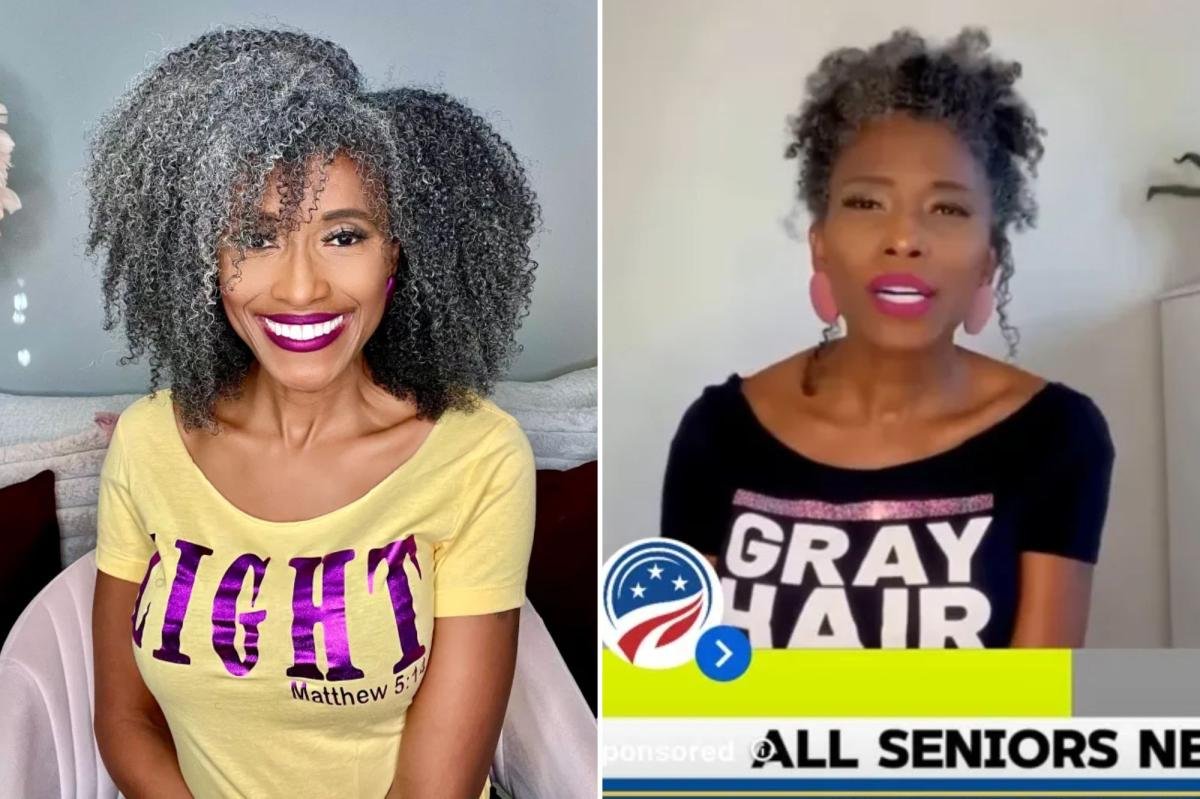
Karen Flowers, a 49-year-old beauty influencer based in Virginia, recently received an ad on YouTube from her cousin. The clip showed an entity that looked just like Flowers promoting a life insurance company, but it wasn’t actually her. It was a deepfake made using his likeness.
“[My cousin] he said, “I’m looking at it.” It’s you. But I know it’s not you,’” Flowers, the founder of Riccio Housea line of holistic hair care products, she told the Post. “Clearly, it was my image. I looked at it and knew exactly which YouTube video it was from. My lips were synced to the words, but they didn’t sound like me.”
Rogue gangs in distant lands steal the images of social media stars and repurpose them for their own purposes, often to create made-up ads for products they’ve never heard of. Influencers, whose livelihoods depend on hard-won credibility and relationships with their followers, find themselves powerless to stop it.
“It’s horrible,” Flowers said.
$893 million stolen
It’s hard to quantify exactly how big the problem is, but Google recently filed a lawsuit a Chinese network called Outsider Enterprise.
The alleged cybercrime group is accused of using Google’s artificial intelligence tools to create fake websites and foil more than 100,000 financial scams. Meanwhile, copying was used, according to the FBI cybercriminals to leech Americans about $893 million in 2025 alone.
The trend of stealing people’s likenesses began with celebrities. For years, in a low-tech version of the scam, criminals created social media accounts that appeared to belong to celebrities and then contacted people pretending to be them, asking for money or gift cards.
In the last year or so, Oprah WinfreyKim Kardashian, Gwyneth Paltrow and other celebrities have all had their images hijacked and used in deepfake videos, often selling unlikely products.
In 2024, Taylor Swift she was made to appear as if she were conducting an online giveaway of expensive Le Creuset cookware. YouTube star MrBeast appeared to sell iPhones for $2 each if “you’re one of 10,000 lucky people,” according to one video. Next went to X to blow up”my deep scam.”
Even the brilliant one Tom Hanks was shot. In 2023, he was transformed into a dental plan promoter. “I had nothing to do with it,” he warned fans on Instagram.
The year before, entrepreneur and television personality Bethenny Frankel is suing TikTok on his image used without permission. He accused the platform of failing to stop deepfake ads which, according to NBC Newsshowed her the sale of counterfeit designer cardigans “with which [Frankel has] no affiliation,” and cited damage to his personal brand.
According to NBC News, Frankel made a post on TikTok “with the intent to educate consumers about the deception,” only for TikTok to remove him, deeming the post “abusive.”
“This needs to be addressed,” Frankel said on “Good Morning America.” “The bigger problem is TikTok and the wild west of social media.”
The case ended up in arbitration, and Frankel’s people said they had “no information on the current status of the case.” TikTok did not respond to a request for comment.
“Good Morning America” published a statement from TikTok that, in part, says: “We have rigorous policies to both protect people’s hard-won intellectual property and keep misleading content off TikTok.”
Fight
Unlike A-listers and big reality stars, influencers and “micro-celebrities” often don’t have the wherewithal to fight back, and tracking down scammers can be nearly impossible.
“I looked up the company [that had the digitally recreated version of me] and took me to a shell company,” Flowers said. “I was never able to reach them. I didn’t know where to send a cease and desist letter.”
Eventually, a consumer advocate from his hometown news station in Virginia stepped in and convinced YouTube to remove the bogus commercial.
YouTube did not respond to a request for comment, although Flowers, who has 102,000 followers on the platform, admitted: “I don’t blame YouTube. I feel like these companies are catching up with AI, which is here to stay.”
Kara MendelsohnShe, a fashion influencer with 125,000 followers on Instagram who worked for Calvin Klein in the 1990s, also had her image stolen and used against her will.
She posted an image from one of the ads on Instagram Stories, writing, “This is NOT me!!! This company stole my image and voice to create this AI ad. There’s even one for a GLP1 that’s NOT me! I hate it and Instagram does nothing to remove it.”
Fraud detection
Meta, which owns Instagram and Facebook, told The Post that identifying this type of content can be a challenge as technology constantly evolves, but said it is continually working to improve its systems and take a step forward.
The company advises users to consider several factors to try to determine whether content was created as a deepfake. They include checking the trustworthiness of the account sharing the content and looking for details that may appear unnatural.
Image theft can surprise a person at the most unexpected moments. Nassia Matsa, a London-based model and journalist, was riding the city’s subway when, she told The Post, “I saw an advert with someone who looked like me. It felt really creepy. The image was from an editorial I did for a Paris-based magazine in 2019.
“[The entity that did the phony ad] he chose different models to look modern and relevant, a very performative act, since none of us were paid or even agreed to be part of this ad.
More recently, “skinfluencer” Arielle Lorre, 40 and living in Los Angeles, was disturbed to find a deepfake of herself talking about a skincare product from a company called Skaind, which she had never worked with, in an interview. The man who gave the interview in the promotion posted on X that his image had also been stolen.
“You can imagine how disturbing it is to see yourself saying things you’ve never said, sitting in an interview you’ve never been in,” he said Magazine Inc. “Not only is it illegal, but it also dilutes my brand.”
The issue highlights what can happen when bad actors use social media and artificial intelligence for their own nefarious purposes. It all drives home a point Frankel made on “Good Morning America” about online videos.
“I want people to know that you have to enter at your own risk,” Frankel said. “You don’t have to operate freely, you have to be protected.
About the Author


