
Spending on Influencer Marketing Italy will reach 425 million euros in 2026, up 10.4% compared to 385 million euros in 2025, according to the sixth annual “Influencer Compensation” report from Italian digital strategy firm DeRev. That’s the fastest growth rate since 2023, nearly three times the 4.05% increase in 2025. But the market-wide gain obscures a starker divide: Celebrity influencers earn less for the third straight year on every platform tracked by DeRev, while mid- and macro-tier creators are the only two tiers reporting gains on Instagram, TikTok and YouTube.
The report is based on approximately 5,000 Italian creator profiles and 865,000 posts published between June 15, 2025 and June 15, 2026 on Facebook, Instagram, TikTok and YouTube.
Celebrity pay continues to decline
DeRev defines celebrities as influencers with more than 3 million followers on Facebook, Instagram or TikTok and more than 1 million on YouTube. Their compensation per post fell across all platforms this year: down 18.8% on Facebook, 9.5% on Instagram, 8.6% on TikTok and 2.4% on YouTube, the third consecutive year of decline across all four. The number of followers is also decreasing. 63.2% of celebrity accounts lost Instagram followers in the past year, and only 36.8% increased their following, compared to 76.7% of mid-tier creators and 68.5% of macro creators.

DeRev CEO Roberto Esposito said this Il Sole 24 Ore that brands have become more wary of the ultra-generalist public whose performance is difficult to measure and whose reputational visibility is constant. He underlined the repercussions of Chiara Ferragni “Pandoro Gate” scandal as an accelerator rather than a cause, arguing that it highlighted how expensive a high-profile partnership becomes once a creator’s credibility is damaged, and that brands react to the loss of trust more severely than the loss of followers alone would suggest.
Mid-level and macro leads on Instagram, TikTok and YouTube
Mid-level creators, defined as those with 50,000 to 300,000 followers on Instagram and TikTok, saw a 9.2% pay increase on Instagram, 7.1% on TikTok and 2.9% on long-form YouTube videos. Macro creators, approximately 300,000 to 1 million followers, gained 7.1% on Instagram, 7.6% on TikTok and 5% on YouTube. They are the only two tiers to see increases across all three platforms this year. In currency terms, DeRev’s price list puts a TikTok post from a macro creator up to 5,400 euros, versus 58,000 euros for a single YouTube video from a celebrity.
Mid-tier posts also have an engagement rate three times higher than celebrity content, 4.56% versus 1.61%, and the number of mid- and micro-tier followers grew 17.7% and 16.9%, respectively, over the year.
Platform by platform
Facebook’s role in influencer marketing has become marginal, DeRev notes, now used more to redistribute content made for other platforms than to run native campaigns. Publishing volume increased significantly among mid-tier (+105%) and macro (+159%) creators, largely through reposts and low-effort, sometimes AI-assisted content with no commercial value. Pay decreased at nearly every level: micro (-11.1%), mid-level (-14.3%), macro (-13.6%), mega (-15.6%), and celebrity (-18.8%).
Instagram remains the leading platform, with post volume increasing across nearly all segments, except celebrities, who posted 16.5% fewer. Pay remained stable between €100 and €300 per post for nano creators (5,000 to 10,000 followers) and increased for every other level below celebrity: micro earned 5.6%, medium 9.2%, macro 7.1% and mega 2.3%, while celebrity pay fell 9.5%.
TikTok’s earnings are stabilizing after two years of steep decline, falling 19% in 2024 and 2% in 2025, before narrowing to a 0.33% decline in 2026. Micro creators gained 2.6%, mid-tier creators gained 7.1%, and macro creators gained 7.6%, while nano creators fell 10%, mega creators fell 0.7%, and celebrities they fell by 8.6%.
YouTube has the highest value per post of any tracked platform. Short films dominate the volume, making up 96.6% of nano-level content and 90% of macro-level content, but campaign spend remains focused on long-form videos. Medium gained 2.9%, macro 5% and mega 1.9%, while nano and micro remained stable and celebrity salaries fell 2.4%. DeRev added Shorts to its price list as a standalone format for the first time, pricing it at about a third of the rate of a standard video.
TikTok’s disclosure gap
Only 0.78% of TikTok’s most engaged posts in Italy contained sponsored content disclosures, DeRev found, compared to 4.46% on Instagram and 29% on long-form YouTube videos. Esposito called the gap an anomaly that is set to come under greater scrutiny now that Italy’s AGCOM code and its ATECO classification for influencers are in place, requiring brands to ensure their campaigns meet disclosure rules.
Where the money goes
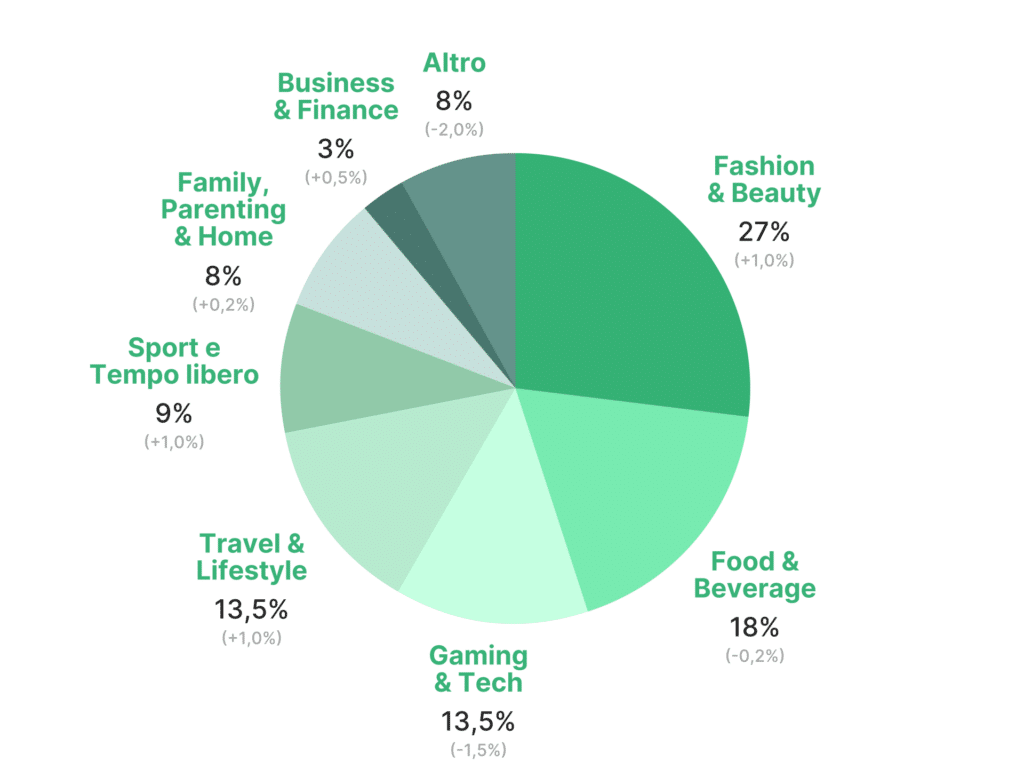
Fashion and beauty remain the most spendable category with 27% of investments in Influencer Marketing, up one percentage point compared to 2025. Food & Beverage maintains second place with 18%, unchanged. Gaming & Tech and Travel & Lifestyle each account for 13.5%. Sports and leisure increased from 8% to 9%, while business and finance grew from 2.5% to 3%, a small but high-value niche where DeRev says the scarcity of qualified creators and the industry’s reputational sensitivity push rates higher.
Image source: DeRev
The full DeRev report is available Here
Sign up for our newsletter
Check out our podcast
About the Author


